
In the tradition of year-end lists, the Knowledge and Information Systems journal has published a list of the top 10 algorithms in data mining, as compiled based on a survey given at the IEEE International Conference on Data Mining. Here they are (along with referenced to relevant wikipedia articles):
[1] C4.5 et al.
[2] k-means
[3] Support Vector Machines
[4] Apriori
[5] EM
[6] PageRank
[7] AdaBoost
[8] kNN
[9] Naive Bayes
[10] CART
Often times, these sorts of lists can seem rather contrived, but I pleased to see that Wu and colleagues have published a well-written--and thoughtfully referenced--survey of the Machine Learning and Data Mining literature, highlighted by pseudocode and reference equations. A great read!
Showing posts with label Articles. Show all posts
Showing posts with label Articles. Show all posts
Monday, January 5, 2009

Friday, December 19, 2008
On Statistical Modeling: The Two Cultures
Yesterday I linked to a pdf copy of Leo Breiman's Statistical Modeling: The Two Cultures, an article I've recently read. For those not familiar, Breiman was, in my view, a central figure in the early days of modern Machine Learning (i.e., 1980+). His work on Classification and Regression Trees, Bagging, and Random Forests were all foundational to the field of Statistical Machine Learning. I think this fact partially contributed to how much I enjoyed reading the aforementioned article--Breiman writes as someone with a deep understanding of his material, the sort that can only be obtained by living its history. He casts the two camps of statistical analysis in terms of a "black box", where the data of interest are generated by the process
 Anaylsis in the data modeling community, he argues, begins "...with assuming a stochastic data model for the inside of the black box" (199):
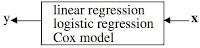
The algorithmic modeling community, however, "...considers the inside of the box complex and unknown. Their approach is to find a function...--an algorithm that operates on x to predict the responses of y" (199):

The overarching message of Breiman's article is an important one that is still relevant today, eight years later. An excerpt summarizes it quite well:
He continues, by pointing out that a model doesn't necessarily have to be simple in order for it to provide useful insight. This point struck me, as, on the surface it seems to defy a central principle of model selection (e.g., MDL, AIC, BIC). Granted, Breiman is referring to a more general type of model selection--data modeling v. algorithmic modeling--but the contrast is still interesting. More importantly, Breiman was exactly right in pointing out the strange statistical reasoning the pervades many biomedical fields--do we want answers to our questions, or do we want to the layperson to understand every step involved in arriving at the answers?


The algorithmic modeling community, however, "...considers the inside of the box complex and unknown. Their approach is to find a function...--an algorithm that operates on x to predict the responses of y" (199):

The overarching message of Breiman's article is an important one that is still relevant today, eight years later. An excerpt summarizes it quite well:
My biostatistician friends tell me, "Doctors can interpret logistic regression." There is no way they can interpret a black box containing fifty trees hooked together. In a choice between accuracy and interpretability, they'll go for interpretability. Framing the question as the choice between accuracy and interpretability is an incorrect interpretation of what the goal of a statistical analysis is. The point of a model is to get useful information about the relation between the response and predictor variables (209-210).
He continues, by pointing out that a model doesn't necessarily have to be simple in order for it to provide useful insight. This point struck me, as, on the surface it seems to defy a central principle of model selection (e.g., MDL, AIC, BIC). Granted, Breiman is referring to a more general type of model selection--data modeling v. algorithmic modeling--but the contrast is still interesting. More importantly, Breiman was exactly right in pointing out the strange statistical reasoning the pervades many biomedical fields--do we want answers to our questions, or do we want to the layperson to understand every step involved in arriving at the answers?
Subscribe to:
Posts (Atom)


 Posts
Posts

